
Redirect Chain Checker (100% FREE)
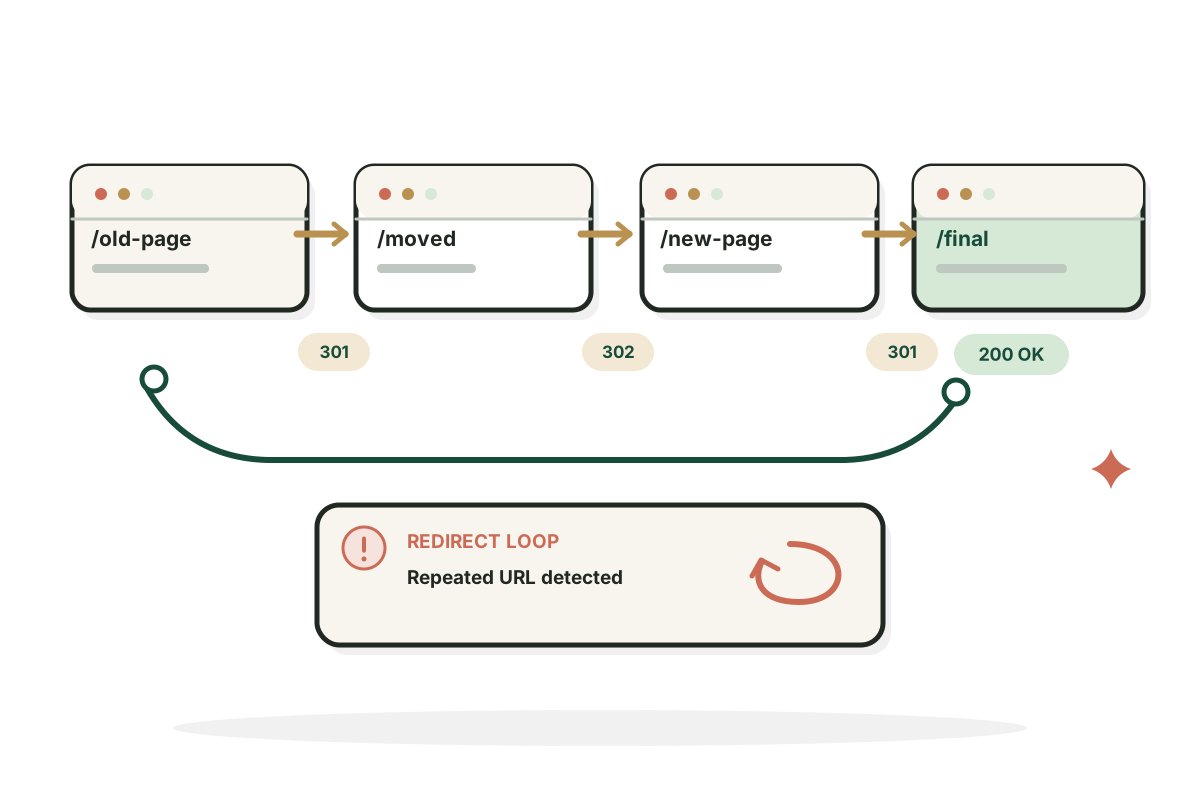
This redirect chain checker shows every stop between an old URL and its destination. Enter a public URL and see each server redirect, its response code, and any loops, failures or long chains.
See every stop between an old URL and its destination.
Free, no signup. The public URL you enter is fetched by our server to read its response. Nothing is stored.
Enter a URL to see every redirect between it and the final page.
How it works
How to use the Redirect Chain Checker in three steps.
- Step 1
Paste the URL
Paste the original URL you want to test.
- Step 2
Follow the chain
Read each hop from start to finish, with its status code.
- Step 3
Shorten it
If redirects are unnecessary, point the old URL straight at the right destination.
Examples
Redirect chains, traced.
Illustrative chains to show how results read.
HTTP to HTTPS, then a moved page
Input: http://example.com/old Consider redirecting the first URL straight to /new.
Result301 to https://example.com/old, 301 to https://example.com/new, then 200. Two hops.
A loop
Input: https://example.com/a Visitors and crawlers never reach a page.
Result301 to /b, 301 back to /a. Loop detected.
A broken destination
Input: https://example.com/promo The redirect works but the target is gone.
Result302 to /spring-sale, which returns 404.
Good to know
Reading redirects.
Permanent versus temporary moves
301 and 308 say a page has moved permanently. 302 and 307 usually mean a temporary redirect. The right one depends on your intent. A site migration usually needs permanent redirects, but there are good reasons for temporary ones too.
What a long chain tells you
Long chains add requests, can slow navigation and make migrations harder to debug. Fix the source redirect where you can, and don't change redirects you don't control. A 403 can mean bot protection rather than a broken page.
FAQ
Questions, answered.
What is a redirect chain?
A sequence of one or more redirects before reaching the final URL.
What is a redirect loop?
When URLs keep pointing back to each other, so the request never reaches a destination.
Which codes are permanent?
301 and 308 generally mean a permanent redirect. 302 and 307 are normally temporary.
Can redirects hurt SEO?
Valid redirects are normal. Unnecessary chains, loops and broken targets can cause crawling and user problems.
Does the tool follow JavaScript redirects?
No. It traces HTTP redirects only, so redirects done in page scripts won't appear.
Why might the checker show a 403 when the website works?
The site may block automated requests. Check the page in a browser before treating it as broken.

Planning a migration? Keep your rankings.
I plan redirects and technical SEO so moves don't cost you traffic.
See SEO services