
Customer Acquisition Cost Calculator (100% FREE)
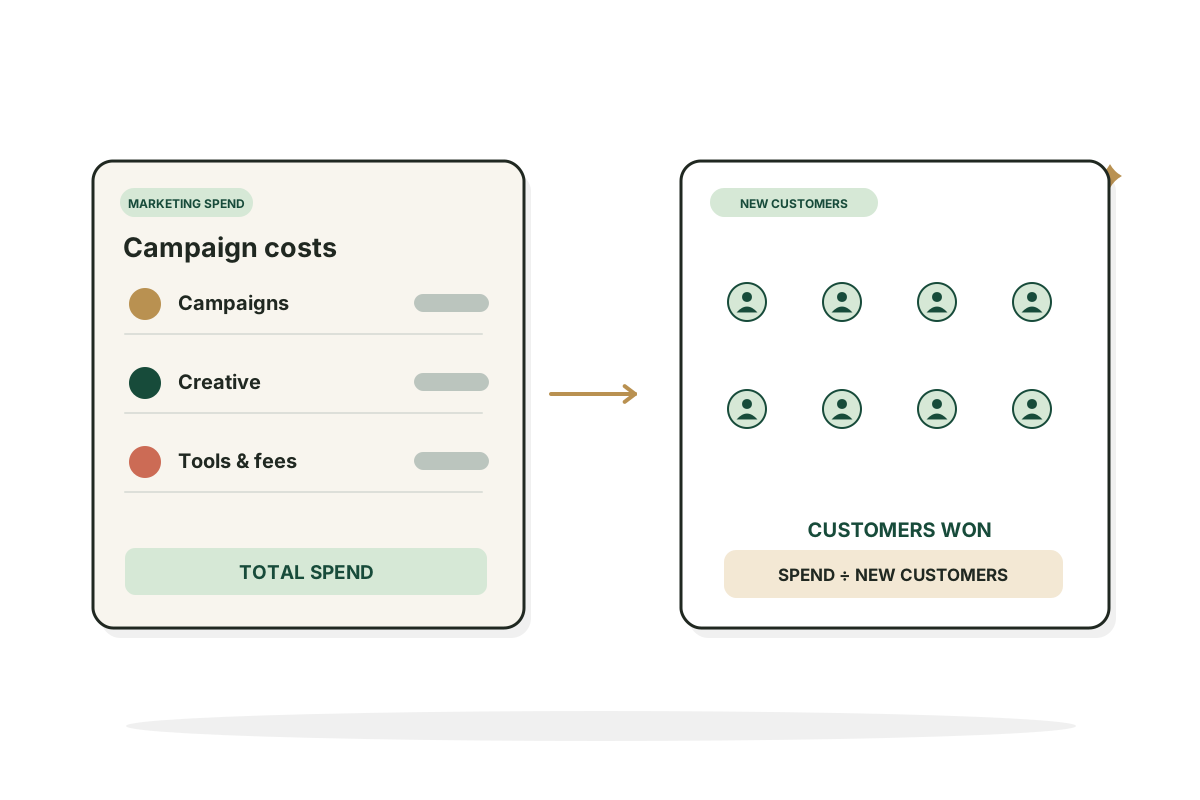
This customer acquisition cost calculator works out your CAC from your marketing and sales costs and the new customers you won in the same period.
How much does it cost to win a customer?
Free, no signup. Runs in your browser, nothing is sent anywhere.
$100.00
Blended CAC for one month.
| Marketing costs | $2,000.00 |
|---|---|
| Sales costs | $1,000.00 |
| Total acquisition costs | $3,000.00 |
| New customers | 30 |
| Marketing share | 66.67% |
| Sales share | 33.33% |
CAC = ($2,000.00 + $1,000.00) ÷ 30 = $100.00. It's an average across every channel, not the cost of any one customer.
How it works
How to use the Customer Acquisition Cost Calculator in three steps.
- Step 1
Choose a reporting period
Use the same month, quarter or year for costs and new customers.
- Step 2
Enter the costs
Include both marketing and sales acquisition spending, not just your ad budget.
- Step 3
Add new customers
Use customers acquired in that same period to get your blended CAC.
Examples
CAC, worked through.
Illustrative numbers to show the formula. They aren't benchmarks.
A monthly CAC
Input: $2,000 marketing, $1,000 sales, 30 new customers in one month. A blended average across every channel that month.
ResultCAC = (2,000 + 1,000) / 30 = $100
When ads look cheap
Input: $600 on ads, $2,400 of salaries and tools, 20 customers. Leaving out salaries and tools makes CAC look five times better than it is.
ResultCAC = $150, not the $30 the ad dashboard suggests.
With a known LTV
Input: CAC $100, lifetime gross profit per customer $450 (from real retention data). Only meaningful when the lifetime value is worked out from real data.
ResultLTV to CAC = 4.5 : 1
Good to know
Getting CAC right.
What is customer acquisition cost?
CAC measures how much a business spends, on average, to gain a new customer. It usually includes advertising, marketing staff, sales costs, tools and a fair share of overhead. A low cost per click isn't a low CAC: if people click but never buy, the spending still exists with no customers to divide it across.
The CAC formula
CAC = total sales and marketing acquisition costs ÷ new customers acquired. Spend $2,000 on marketing and $1,000 on sales in a month, gain 30 customers, and CAC is $100. It's a blended average, so it doesn't prove each customer cost $100 or show which channel did the work.
Costs people forget
Salaries, contractor or agency fees, software, creative production, commissions and sales support time. Keep periods consistent: quarter costs need quarter customers. For channel CAC you need believable attribution for that channel and period. Don't divide one platform's ad spend by all your customers.
Is a high CAC automatically bad?
No. CAC only means something next to how much gross profit customers bring in and how long it takes to earn the spend back. A business with long recurring revenue can afford a higher CAC than one making a small one time sale. Compare it with your own unit economics, not a universal target.
FAQ
Questions, answered.
What is the formula for customer acquisition cost?
Add sales and marketing acquisition spending for a period and divide by the number of new customers acquired in that period.
Should I include salaries in CAC?
Yes, if they're spent on acquiring customers. Allocate shared team costs consistently and note how you did it.
Is CAC the same as cost per acquisition (CPA)?
Not necessarily. CPA can mean the cost of a lead, signup or other campaign action. CAC is the cost of an actual new customer.
What is blended CAC?
Total acquisition spending divided by all new customers in the period, regardless of channel. Channel CAC uses one channel's attributable spend and customers.
What if I spent money but acquired no customers?
CAC can't be calculated with zero new customers. The calculator shows your total spend and "No customers acquired" instead of a misleading number.
Should I include existing customer renewals?
No. Renewals aren't new customers. Use genuinely new customers for standard CAC.
How do I know whether CAC is healthy?
Compare it with contribution margin, lifetime gross profit, payback time and your business model. There's no single CAC target for every industry.
Can this calculator show customer lifetime value?
Only the LTV to CAC ratio, and only if you enter a lifetime value you've worked out from real retention and margin data. It never invents one.

CAC too high? Let's find out why.
I start by finding the real constraint, then fix that first.
See growth strategy